The Simple Formula
Roasting a turkey takes about 15 minutes per pound at 325°F, and you’re aiming for an internal temperature of 165°F in the thickest part of the breast and thighs. That’s the baseline every Toronto home cook needs before the oven even preheats.
Whether you’re hosting your first Thanksgiving in a Liberty Village condo or you’re the designated bird wrangler for your extended family’s annual Scarborough feast, nailing the timing is half the battle. The math itself is straightforward, but the real challenge is knowing when to start, how to check doneness without opening the oven every twenty minutes, and what to do if your bird is running ahead or behind schedule.
This guide walks you through the full process, from the tools you’ll need to the safety checks that keep everyone at the table happy and healthy. We’ll cover prep work, step-by-step roasting instructions, and how to verify your turkey is perfectly cooked without relying on guesswork. By the time your guests arrive, you’ll have a golden, juicy centerpiece and the confidence that comes from knowing exactly what you’re doing.
What You’ll Need Before You Start
Before you start worrying about cooking time, let’s make sure you’ve got the right gear. The good news? You don’t need a kitchen full of fancy equipment to roast a great turkey. Here’s what actually matters:
- Meat thermometer (digital instant-read is best), this is your insurance policy against dry, overcooked meat or undercooked safety hazards
- Roasting pan with a rack, keeps the turkey elevated so heat circulates evenly and the bottom doesn’t get soggy
- Heavy-duty oven mitts, a 15-pound turkey is hot, heavy, and awkward to maneuver
- Basting brush or bulb baster, optional for keeping the skin moist and golden, but not make-or-break
- Aluminum foil, for tenting the bird if it’s browning too fast
The meat thermometer deserves its own spotlight here. You can follow the 15-minutes-per-pound calculation perfectly, but your oven might run hot, your turkey might be shaped differently, or a dozen other variables could throw off the timing. The thermometer doesn’t lie. It tells you exactly when your bird hits that critical 165°F mark, which is the only number that truly matters.
If you’re scrambling for last-minute supplies in Toronto, most Loblaws and Metro locations stock decent digital thermometers in the kitchen gadget aisle. Kitchen Stuff Plus on Yonge Street is also a solid bet if you want something more reliable. Grab one now, and you’ll use it for years of holiday dinners, not just this turkey.
The Math: Calculating Your Turkey’s Cooking Time
Here’s the baseline you’ve been waiting for: the turkey about 15 minutes per pound rule. This is your starting point for estimating how long your bird needs in the oven at 325°F. A 10-pound turkey clocks in around 2.5 hours. Got a 15-pounder for the whole extended family? You’re looking at roughly 3 hours and 45 minutes. Hosting a crowd with a 20-pound giant? Plan for close to 5 hours. Multiply your turkey’s weight by 15, divide by 60, and you’ve got your estimated cook time in hours.
But here’s the thing: this cooking ratio is a guideline, not gospel. Think of it as your ballpark figure, not a precise countdown. Several factors can nudge that timing up or down. Stuffed turkeys take longer than unstuffed ones because the stuffing needs to hit 165°F too, adding 30 to 45 minutes to your total time. If your turkey went straight from fridge to oven instead of sitting at room temp for 30 minutes, tack on extra time. And let’s be honest, not every oven in Toronto runs true to its dial. Some run hot, some run cool, and that five-degree difference matters over several hours.
The takeaway? Use the 15-minute-per-pound calculation to set your timer and plan your day, but don’t panic if your turkey finishes 20 minutes early or needs an extra half hour. Small variations are completely normal. What matters most is hitting that safe internal temperature of 165°F, which we’ll cover next.
Safety First: Temperature Matters More Than Time
Here’s the truth nobody wants to hear: your turkey timer is a liar. Those little pop-up buttons that come stuck in the bird? They’re notoriously unreliable, often popping way too late (when your breast meat is already dry as cardboard) or sometimes not at all. The cooking time calculation we covered earlier gets you in the right neighborhood, but it’s not a guarantee. Your oven might run hot. Your turkey might have started colder than you thought. You might have opened the oven door six times to check on things.
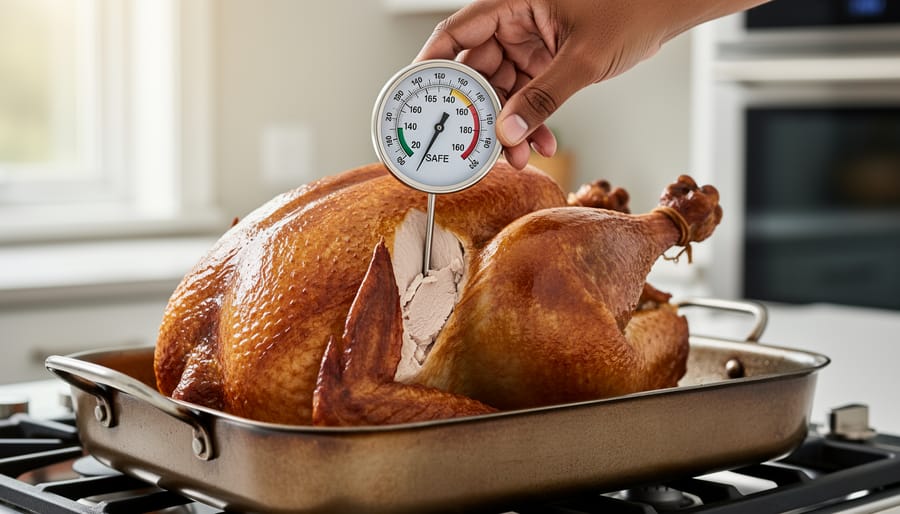
The only number that actually matters is 165°F (74°C) measured in the thickest part of the breast and the innermost part of the thigh, avoiding the bone. This isn’t some arbitrary suggestion, it’s the 165°F safe minimum temperature that kills harmful bacteria like salmonella. Undercook your turkey and you’re risking a holiday nobody will forget (for all the wrong reasons). Overcook it because you’re paranoid, and you’ve wasted hours of work on a dry, disappointing centerpiece.
Invest in a decent instant-read thermometer if you haven’t already. Insert it into the meat without touching bone (bone conducts heat differently and will give you a false reading). When your turkey hits that magic 165°F, pull it out and let it rest for at least 20 minutes. The temperature will actually climb another 5-10 degrees as it sits, redistributing those juices throughout the meat. This resting period isn’t optional, it’s when your turkey transforms from good to genuinely impressive.
Step-by-Step: Roasting Your Turkey to Perfection
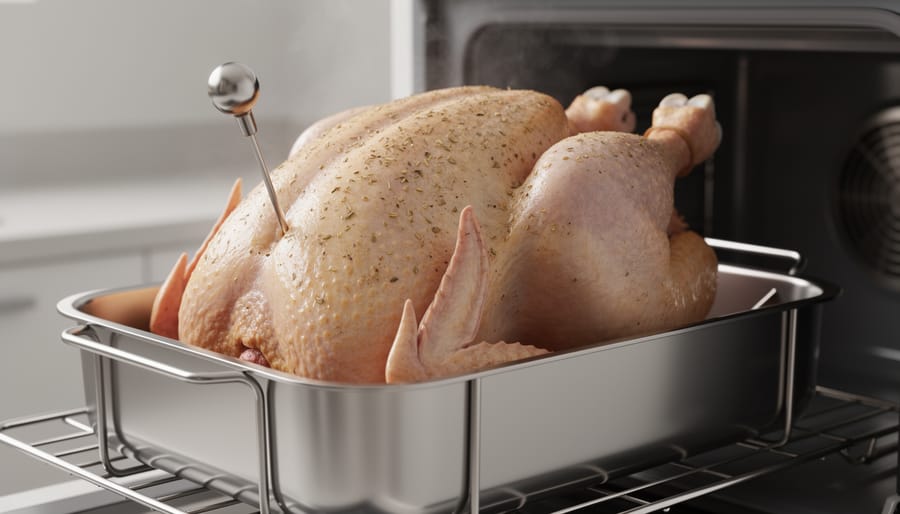
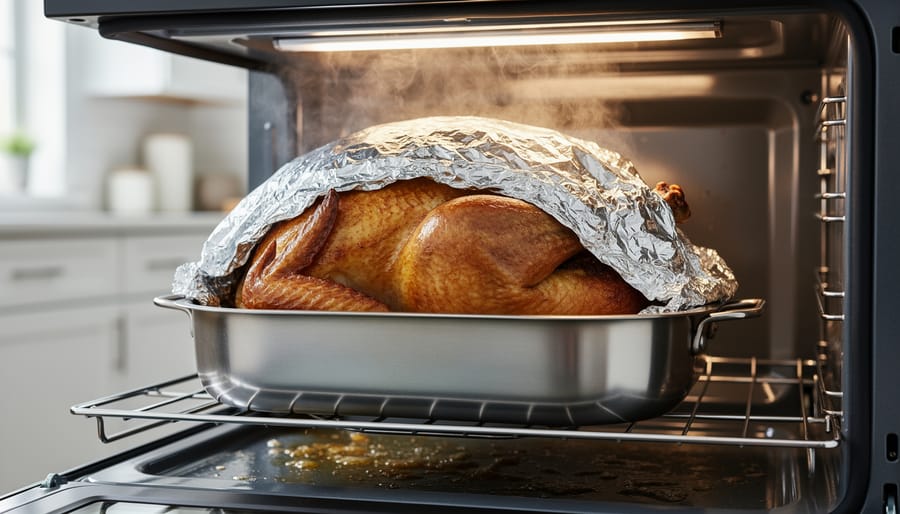
Here’s your turkey ready for the oven, let’s walk through the full roast so you nail it this holiday season.
Start with a completely thawed bird. If you’re pulling it from the freezer, plan roughly 24 hours of fridge thawing per 5 pounds. A frozen turkey won’t cook evenly, and you’ll end up with raw spots near the bone while the breast dries out.
Once thawed, unwrap the turkey and reach into both cavities, front and back, to pull out the giblets and neck. Pat the entire bird dry with paper towels, inside and out. This step matters more than you’d think: a dry surface browns beautifully, while a wet one steams and stays pale.
Season however you like, salt, pepper, herbs, a rub, whatever fits your menu. If you’re going simple, kosher salt and black pepper do the job. Tuck the wing tips under the body so they don’t burn, and if you have kitchen twine, tie the legs together to help the bird cook evenly.
- Preheat your oven to 325°F or higher. Some cooks go for 350°F to speed things up and get crispier skin, but 325°F is the safe baseline that keeps the meat moist.
- Place the turkey breast-side up on a rack in your roasting pan. The rack lets heat circulate underneath and prevents the bottom from getting soggy.
- Calculate your cooking time using the 15-minutes-per-pound guideline. A 12-pound turkey should take around 3 hours, but write down your estimate and set a timer for the halfway mark so you can check progress.
- Slide the pan into the oven and let it roast. Basting with pan drippings every 45 minutes is optional, it adds flavor and moisture but isn’t mandatory if you’re keeping the oven closed for steady heat.
- If the skin starts browning too fast, tent the breast loosely with aluminum foil. You can remove it in the last 30 minutes to crisp up the top.
- Start checking the internal temperature about 30 minutes before your estimated finish time. Insert the thermometer into the thickest part of the breast and the innermost part of the thigh, avoiding the bone. You’re aiming for 165°F in both spots.
- When the temperature hits 165°F across the board, pull the turkey out and let it rest on a cutting board for 20 to 30 minutes before carving. The juices redistribute, and the meat stays tender.
If you’re shopping last-minute for fresh produce to round out your meal, grab any missing ingredients while the turkey roasts, you’ve got time.
Don’t panic if the timer goes off and the temp isn’t quite there yet. Just close the oven and give it another 15 to 20 minutes. Better to cook a bit longer than to serve undercooked poultry. Once it’s done, you’re golden.
How to Know When Your Turkey Is Actually Done
The only way to know your turkey is truly done is with a meat thermometer reading 165°F (74°C). Insert the thermometer into the thickest part of the breast, pushing it in until it reaches the center, then check the innermost part of the thigh near the body. Make sure you’re hitting meat, not bone, which throws off the reading and gives you a false high number.
If your breast hits 165°F but the thigh is still at 160°F, leave the bird in. The thigh takes longer because it’s denser and sits closer to the body cavity. Check every 10 minutes until both spots register safe. If the breast is climbing past 170°F while you wait, tent that area with foil to slow the cooking and keep it from drying out.
Golden-brown skin and clear juices running from the thigh are good visual signs, but they’re backup singers, not the lead. A turkey can look perfect and still be undercooked inside, or overcooked and dry despite beautiful color. Trust the thermometer.
If your turkey hits temperature early, tent it loosely with foil and let it rest on the counter for 20 to 30 minutes. The internal temp will actually climb a few degrees as the heat redistributes, and the juices settle back into the meat. Running behind schedule? Don’t panic. Bump the oven to 350°F if you need to close the gap, but keep checking temperature every 15 minutes so you don’t overshoot. Your guests can snack on a single-pan side while they wait.
Common Questions Toronto Cooks Ask About Turkey Timing
Does stuffing my turkey change the cooking time?
Yes, a stuffed turkey needs an extra 15 to 30 minutes beyond the basic calculation. More importantly, the stuffing itself must reach 165°F (74°C) in the center, so check both the turkey and the stuffing with your thermometer.
Can I crank the oven higher to cook my turkey faster?
You can roast at temperatures above 325°F to speed things up, but you’re gambling with dry breast meat. Higher heat cooks the outside faster than the inside, so if you go this route, watch your thermometer like a hawk and be ready to tent with foil.
What if my oven runs hot or cold?
Toronto apartments are notorious for quirky ovens. Use an oven thermometer to check the actual temperature, then adjust your dial accordingly. Your meat thermometer is your safety net here, so rely on internal temp rather than trusting the timer blindly.
Should I use my oven’s convection setting?
Convection can reduce cooking time by about 25 percent because it circulates hot air more efficiently. Just monitor closely and start checking temperature earlier than your calculated time suggests.
One question that comes up every year: do you really need to baste? Honestly, it’s optional. Basting adds moisture to the skin and helps with browning, giving you that magazine-cover look. But opening the oven repeatedly drops the temperature and extends cooking time. If you want to baste, go for it every 45 minutes or so. If you’d rather skip it and keep the oven door closed, your turkey will still turn out just fine, especially if you’ve rubbed it with butter or oil before roasting.
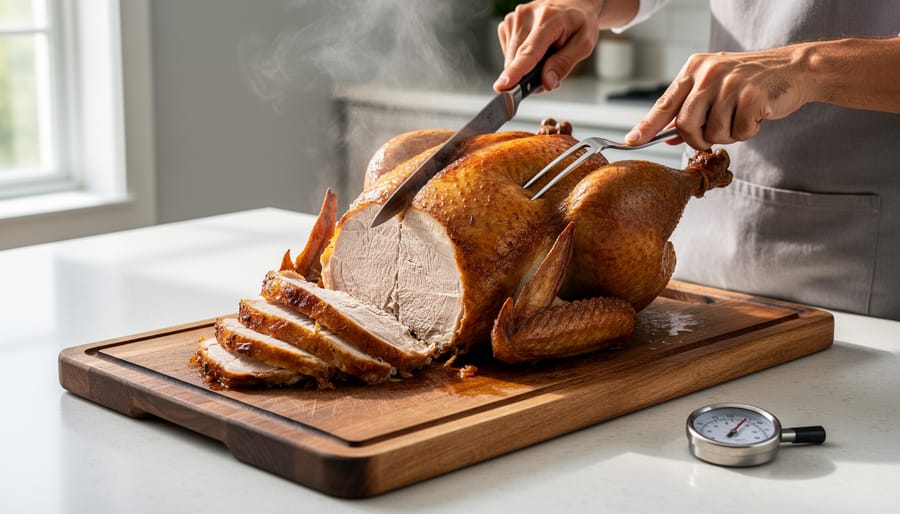
You’ve got the formula: 15 minutes per pound gets you started, but that meat thermometer reading of 165°F is what actually gets dinner on the table. Don’t sweat the small stuff or chase some impossible ideal. If the turkey’s safe, moist, and tastes good, you’ve nailed it. Whether you’re carving in a Leslieville loft or a Scarborough bungalow, your Toronto crew is there for the company, not to judge your basting technique. Set your timer, trust your thermometer, and save some energy for that holiday dessert. You’ve got this.